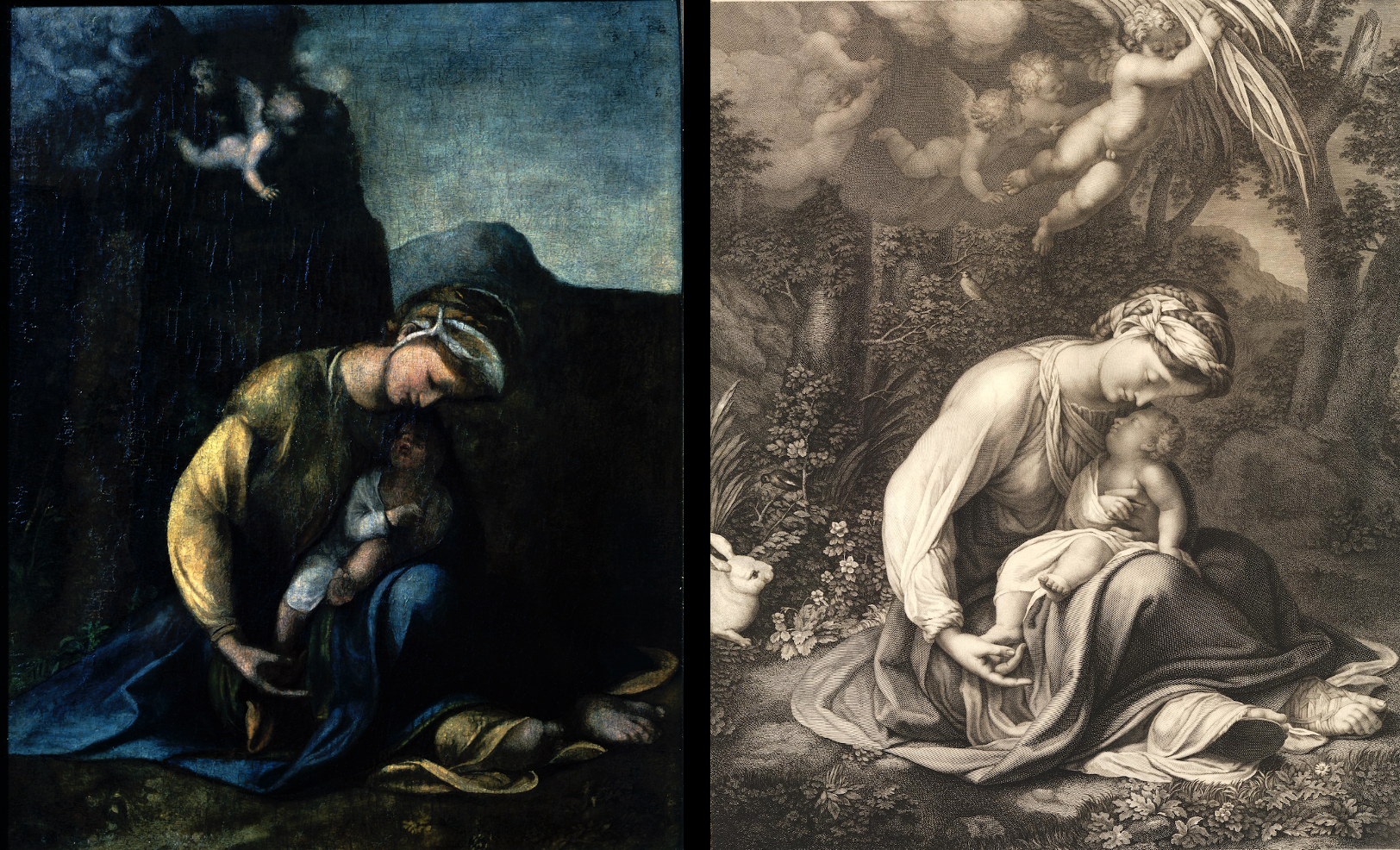
Lady Miller, una stroncatura di Correggio (1770)


“La Maddalena ha la faccia di un’idiota… i suoi capelli sono troppo corti e lisci, non riccioli naturali, ma pesanti e unti… il suo atteggiamento è innaturale e forzato… il braccio e la mano, che pendono verso il basso, sono sproporzionati; le dita sono lunghe, sottili e magre, come quelle di una donna storpia”. Sono solo alcune critiche, e neppure le più violente, che Lady Miller rivolse a una pala d’altare del Correggio, la Madonna di San Girolamo, vista a Parma nel novembre 1770.
Per raccontare il viaggio in Italia assieme al marito (1770-1771), Anna Miller-Riggs, aveva scelto la forma epistolare ma, significativamente, in forma anonima. Nella prima edizione, in tre volumi, l’opera reca infatti il titolo Letters from Italy describing the Manners, Customs, Antiquities, Paintings etc. of that Country, in the years MDCCLXX and MDCCLXXI to a Friend residing in France by an English Woman (London, Dilly 1776).
Di origini irlandesi e di famiglia facoltosa, Anna Riggs (1741-1781), aveva sposato il capitano John Miller nel 1765. L’anno seguente, Horace Walpole visitò la coppia a Batheaston, presso Bath, e descrisse la nuova casa, il giardino e il paesaggio circostante: “un piccolo regno con grandi pretese”, conclude tagliente Walpole [1]. Passano dieci anni e Anna Miller-Riggs compare di nuovo in una lettera dello scrittore inglese: infatti sono appena uscite le Letters from Italy e ne scrive a Horace Mann perché l’ha visto citato in quel libro; è l’occasione per parlare di nuovo dei Miller, con alcuni pettegolezzi e, soprattutto, con una puntuta critica al profilo culturale della padrona di casa:
“Dieci anni fa conobbi lei e suo marito, suo fedele compagno di viaggio, a Bath, vicino a cui possiedono una piccola casa con un giardino in una bella posizione a Bath Easton. Erano persone molto semplici e civili, e vivevano vicino alla madre di lei, Mrs Riggs, una rustica specie di umorista inglese. Hanno finito la loro fortuna economica, e se ne sono andati in Francia per mettervi rimedio. In Francia sua madre è stata lasciata con i nipoti, mentre la coppia affezionata viaggiava in Italia. Da lì sono tornati: lei con la testa rivolta alla Francia e alle bouts-rimés [2], lui con la sua alla virtù. Hanno fondato un’accademia poetica a Batheaston, da cui sprigionano soggetti, distribuiscono premi e pubblicano le poesie premiate, ma si rendono completamente ridicoli, il che è un peccato visto che sono persone di buona indole e buone intenzioni. La povera patronessa arcadica non è in grado di scrivere correttamente una sola parola di francese o italiano in tutti i suoi tre volumi di viaggio” [3].
Come si vede, non è tanto il libro di viaggio a suscitare le critiche di Walpole, quanto le singolari iniziative poetiche di Lady Miller (che pure riuscirà ad attirare a Batheaston figure come David Garrick, Samuel Johnson e Anne Seward) [4]. Lo scrittore si era già divertito a prendere in giro questa “poetic academy” in una lettera a Lady Ailesbury (1775) [5]: da quando i Miller erano tornati dall’Italia, la loro residenza si era trasformata in un nuovo Parnaso (o in un nuovo monte Pindo); infatti, mentre il capitano faceva discorsi edificanti e ostentava anelli con cammei (antichi?) [6], la moglie promuoveva ogni settimana delle gare poetiche, lei che era tornata dal Grand Tour “come una bellezza, un genio, una Saffo, una decima musa”. Gli ospiti dovevano creare componimenti secondo lo schema dei bouts-rimés, sviluppando cioè dei versi a partire da una serie preordinata di parole in rima, ad es. “confess-express, detest-molest, light-might” [7]; a questo punto una giuria sceglieva i migliori e Lady Miller – nuova Calliope, annota beffardamente Walpole – premiava i vincitori.

Come se non bastasse, al centro della cerimonia c’era il grande vaso di pietra della drawing room: coronato di mirto, ospitava i componimenti poetici degli ospiti dei Miller. Si raccontava provenisse da Frascati, nei pressi della villa di Cicerone [8], e per questo veniva soprannominato “Tully’s vase” (o “Tully’s urn”) [9].
Nella lettera a Lady Ailesbury, dunque, Walpole ridicolizza le pretese poetiche di Anna Miller e della sua compagnia, tanto più che i vari componimenti erano stati addirittura pubblicati in Poetical Amusements at a Villa near Bath; ma Lady Miller non si fermò a questa prima antologia: seguirono altre raccolte di versi anche negli anni seguenti (1776, 1777, 1781).

Horace Walpole non fu il solo a storcere il naso per questo attivismo, sicuramente sproporzionato rispetto al livello letterario dell’intera iniziativa; ne nacque un dibattito tra critici e difensori della Miller [10] che ebbe un’appendice grafica nella caricatura eseguita da Matthew Darly: l’esagerata parrucca di Mrs. Miller (avrà il titolo di Lady solo nel 1778) è contrassegnata da riferimenti al suo circolo letterario ed è coronata da un Pegaso rampante e da un vaso – il presunto vaso antico dalla villa di Cicerone, su un piedistallo [11]. Il vaso “di Cicerone” compare persino sul monumento funerario di Lady Miller, all’interno dell’abbazia di Bath, realizzato da John Bacon (1740-1799).

È in questo periodo di notorietà per Anna Miller-Riggs, che escono le Lettere dall’Italia, indirizzate a “a friend residing in France” (si trattava a quanto pare della madre, che nel frattempo accudiva i figli della coppia).

Le Letters furono senz’altro un mezzo per accreditarsi pubblicamente come donna di cultura e di gusto, operazione riuscita fino a un certo punto se, anni dopo, la scrittrice Frances (Fanny) Burney la dipinge così:
Lady Miller è una signora di circa quarant’anni, rotonda, grassoccia e dall’aspetto rozzo; mentre il suo unico obiettivo è quello di apparire come una donna elegante e alla moda, il suo unico risultato è di apparire una donna normale, e con una vita molto comune, con addosso abiti eleganti. Ha modi vivaci, un’aria di finta importanza e maniere ben poco eleganti [12].
Anche se non esplicitato, il modello seguìto da Lady Miller dovettero essere le Letters di Lady Montagu: per quanto i suoi viaggi in Europa, Africa e Asia fossero ben anteriori, le sue lettere vennero pubblicate a partire dagli anni ’60 del Settecento. Oltretutto Lady Montagu proponeva un’idea di viaggio improntata a una sensibilità e un gusto schiettamente femminili [13]. Che anche Lady Miller seguisse questo approccio lo conferma la pressoché totale marginalizzazione del marito John, che pure la accompagnò nel viaggio, all’interno delle Lettere. Uno degli obiettivi della pubblicazione, a diversi anni di distanza dal viaggio, era arricchire il prestigio del salotto di Batheaston e di togliergli quel certo tono provinciale: nonostante le critiche di Walpole, i tre volumi della prima edizione (1776) ebbero una buona accoglienza, tanto che l’opera venne riproposta già l’anno seguente.
Le ragioni di questo discreto successo sono piuttosto semplici: da un lato era inusuale che una figura femminile raccontasse le esperienze del Grand Tour, dall’altro il resoconto del viaggio era vivace e ricco di spunti e di temi (ad esempio quando si parla della vita teatrale in Italia [14]).
Al centro delle Letters ci sono gli artisti e le opere d’arte, che Lady Miller descrive in abbondanza città per città, senza avere però la pretesa di sembrare una studiosa o una specialista [15]: Anna ha letto i libri di viaggiatori che l’hanno preceduta, in particolare Cochin e Lalande [16], e mostra di conoscere l’opinione di quelli che chiama “virtuosi” o “connoisseurs”; in alcuni casi ha consultato saggi di eruditi locali, ma soprattutto dà l’impressione di appoggiarsi al parere di guide e ciceroni, raccogliendo informazioni talora imprecise; quanto al Correggio, difficilmente derivano da una lettura diretta di Vasari le presunte improprietà nel disegno che la scrittrice gli rimprovera in più punti (questo giudizio negativo era ormai divenuto una sorta di luogo comune).
La preparazione piuttosto approssimativa di Lady Miller risalta anche a proposito della biografia di Antonio Allegri: scrive che è nato (e morto) a Parma, ma poche pagine dopo lo collega alla città di Correggio (nome che viene sorprendentemente scambiato con Careggi a proposito dell’Accademia Neoplatonica fondata dai Medici) [17]. Insomma, è proprio nell’ambito delle arti figurative che cogliamo i pregi e i limiti della scrittura di Lady Miller: ovunque nelle sue descrizioni – a volte minuziose, a volte sbrigative, non di rado interrotte da battute di spirito o da note autoironiche – domina il desiderio di apparire priva di pregiudizi e libera dal condizionamento degli esperti e dei più celebri scrittori di viaggio [18].

Come per quelle di altri artisti, anche per le opere di Antonio Allegri via via incontrate scendendo lungo la Penisola Lady Miller cerca di offrire informazioni esaurienti (qui in appendice si trova l’elenco dei dipinti citati, con presenze e assenze ora più, ora meno prevedibili). Davanti alla Madonna di San Girolamo, il cosiddetto Giorno allora nella galleria dell’Accademia Reale di Parma, il proposito di mostrare la propria indipendenza di giudizio assume però un tono talmente polemico da apparire ridicolo (v. appendice). Tanto più se lo si confronta con quello usato, poche pagine dopo, a Modena, dinanzi alla copia della Notte eseguita da Giuseppe Nogari (v. appendice) [19].

La “critical examination of Corregio’s famous picture” [20] inizia dalla Vergine, alla quale il pittore avrebbe dato il volto tipico delle “persone di rango più basso” o dei “contadini e in più, addirittura, uno sguardo da ebete; e poi è troppo abbronzata, così da sembrare una vendemmiatrice. Il Bambino è uno dei più brutti che si siano mai visti”: “il viso è corto, la bocca larga e le labbra rivolte verso l’esterno”. Ma il peggio è riservato alla Maddalena che invece – prima e dopo Lady Miller – è forse la figura più apprezzata del quadro: oltre ad avere un’espressione stupida, assume un atteggiamento così innaturale da far sembrare improbabile – vista l’inclinazione del corpo – il suo accostarsi al piede del Bambino. Le braccia, le mani e le dita sono sproporzionate, ma non basta: “le dita dei piedi sono lunghe, gonfie e arrossate; il suo abito è disordinato; le pieghe del drappeggio sono disegnate in modo confuso”. Il san Girolamo le sembra un miserabile vecchio mendicante. La bocca aperta dell’angelo le ricorda quella del “pesce San Pietro”. Insomma, la viaggiatrice inglese trova il dipinto “così sgradevole e deludente sotto ogni punto di vista” da esprimere queste e altre accuse proprio davanti alle guide (“ciceroni”), che a loro volta si scandalizzano e difendono “il divino, il grande Correggio” [21]. Una reazione prevedibile: tra gli altri (solo cinque anni prima dell’arrivo a Parma della viaggiatrice inglese), Francesco Algarotti aveva celebrato la Madonna di San Girolamo, anteponendo senza esitazioni il Correggio a Raffaello [22].
Come era prevedibile, questa stroncatura non lasciò alcun segno (del resto, più in generale, il punto di vista femminile sulla storia dell’arte faticò a lungo per prima di essere accettato) [23]. Diversi anni più tardi, Hester Lynch Piozzi, una viaggiatrice che oltretutto apparteneva a un ambito culturale non così distante da quello di Lady Miller, loderà senza esitazione la Madonna della Scodella e soprattutto la Madonna di San Girolamo, celebrandone l’autore come “uno dei più grandi geni apparsi sulla terra”; lo apprezza perché capace di realizzare grandi cose nonostante fosse “privo di cultura come anche dei mezzi per procurarsela e lo inserisce in una composita schiera (ai nostri occhi piuttosto sorprendente) di autori di opere immortali: George Lillo, John Bunyan, Samuel Johnson, Fénelon (e Michelangelo) [24].
Claudio Franzoni
APPENDICE
Letters from Italy describing the Manners, Customs, Antiquities, Paintings etc. of that Country, in the years MDCCLXX and MDCCLXXI to a Friend residing in France by an English Woman, London, Dilly 1777
I, p. 89 (Torino, collezioni reali):
“A sketch in little, by Correggio, from his large picture of Io. Perfect of its kind, and universally admired by all connoisseurs, excepting mons. Lalande, who believes it a bad copy”.
I, p. 178 (Genova, palazzo del marchese Francesco Maria Balbi):
“A Nativity; the Virgin-mother most beautiful; the child is nature itself; he shrinks, and turns himself from the cold air towards the bosom of the Virgin, as if to seek shelter from the situation to which a new-born infant must necessarily feel himself exposed, added to the inclemencies of the weather, without any other protection than that of a ruined stable, or bed than a heap of straw upon which he is laid. This scene is strongly represented by the energetic pencil of the great Corregio”.
I, p. 266 e sgg. (Parma, cupola del duomo):
“The Cathedral (Il duomo) is a spacious church, remarkable for its cupola, painted by Corregio, though it is now so much spoiled, that it requires a great deal of faith, and a strong imagination, to believe it the remains of a chef d’œuvre of so great a master”.
I, p. 266 e sgg. (San Giovanni, affreschi, Deposizione, Martirio dei Quattro Santi):
“The Church of St. John is shewn to strangers, on account of the Cupola, that also being painted by Corregio; but it is so much defaced, and so ill-lighted, that little can be made of it: it has been also repaired by another painter, at the desire of the Monks, to whose convent this church belongs. In the fifth chapel, to the right, is a descent from the cross, and a martyrdom of St. Placid, both by Corregio. The first is the best, but they are both incorrectly designed; their colouring is their principal merit, and that is not sufficiently glowing”.
I, p. 267 (Parma, Madonna della Scodella):
“In the Church of St. Sepulchre is another picture of his, representing a little Jesus, a Madona, and a St. Joseph gathering palms. The three faces are very fine, but the whole is faulty in the drawing, and the colouring weak. This picture is called the Madona della Scodella, on account of the porringer she holds in one of her hands. In the back ground is an ass, and an angel taking care of him. The subject means, doubtless, to represent a repose of the flight into Egypt”.
I, pp. 269-272 (Parma, Madonna di San Girolamo):
“I do not question your being extremely impatient to hear why I was so disappointed in the famous picture of Corregio, in favour of which the whole world of virtuosi can scarce find words to express the enthusiasm of their feelings, when they would display its merits. Notwithstanding my prejudices in its favour were strong, yet I must confess, though I expose myself to the censure of the first connoisseurs, that I do not like this picture; and now I will proceed to give you its description as well as the reasons of my disapprobation. It is a very large picture, higher than wide: about the middle of the canvass the Virgin is seated with the Infant Jesus on her knees; a little to the right, and forward, Mary Magdalen, in a kneeling posture, holds the foot of the little Jesus in one of her hands, and is supposed to incline her head to kiss it; the other hand hangs down: to the left, and on the fore-ground, appears St. Jerome; his back turned to the spectators, but by looking over his shoulder he discovers his profile: between him and the Virgin, and farther back, is an angel who sings from a book: behind Mary Magdalen is another angel, or young man, who seems to drink out of a vase. The character of the Virgin’s face is such as you often see in the lowest rank of people or peasants; an unmeaning breadth, l’air d’hibou [“l’aria di un gufo”, uno sguardo da ebete], le visage plâte, &c. She appears extremely tanned, like a vendangeuse [vendemmiatrice]. The colouring is coarse, and the shadowing of a dirty brown. The Infant is one of the homeliest children I ever saw, that was not deformed. The face short, the mouth wide, and the lips turn outwards. The more one considers the countenance, the more it seems to be in contorsions. The anatomy is false, and the attitude ungraceful, to say the least. The Magdalen has the face of an idiot; and not of a handsome one. The little Jesus has hold of her by the hair; but his figure and face are turned from her. Her hair is too short and straight, not curling in natural ringlets, but heavy and greasy. Her attitude is so unnatural and strained, that it is not possible for her, in her present inclination of body, to apply her lips to the foot of the Infant ; possibly the might her ear, for she is in the moment of raising his foot towards her head: her arm and hand, that hang down, are ill proportioned; her fingers long, lank, and lean, like those of a crooked woman; her arm thin, skinny, and flat; her elbow sharp, and seems as if it would wear a hole through the drapery; her toes are long, swelled and red; her dress disorderly; the folds of her drapery confusedly drawn; that of the Virgin is as bad. As to St. Jerome, he has the air of a miserable old beggar. The singing angel opens a mouth like that of a john-dory [pesce San Pietro]; and the young person behind the Magdalen has the same mouth and lips with the other personages; the latter he projects in an extraordinary manner towards the vase. In the back ground appear some remains of a ruined theatre, with cottages; they stick to the back of the angel’s head, so ill is the keeping preserved. There is also a kind of withered faggot, which is meant for a tree. Vexed at finding this picture every way so disagreeable and disappointing, I could not avoid criticising it a little before the Ciceroni; who exclaimed at my finding fault (though he could not deny that he perceived some absurdities) with the work of il divino, il grande Corregio”.
I, p. 292 (Modena, Palazzo Ducale, Adorazione dei Pastori):
“An Adoration of the Shepherds, said to be by Corregio. The Virgin is uncommonly handsome”.
I, pp. 295 e sgg.: (Modena, Palazzo Ducale):
“Here is a prodigious fine copy of that picture, called il (sic) Notte di Corregio. The original was sold with several other glorious pictures, for a great sum of money to the King of Poland. What must the original be, when the copy is so admirable! which is said, however, to resemble it wonderfully. It surprises me very much to see how different the characters are in this picture from that famous one of his at Parma, which I described to you. The subject is a Nativity; and the extraordinary beauty of this picture proceeds from the clair obscure: there are two different lights introduced, by means of which the personages are visible; namely, the light proceeding from the body of the child, and the moon-light. These two are preserved distinct, and produce a most wonderful effect. The child’s body is so luminous, that the superficies is nearly transparent, and the rays of light emitted by it, are verified in the effect they produce upon the surrounding objects. They are not rays distinct and separate like those round the face of a sun that indicates an insurance-office; nor linear, like those proceeding from the man in the Almanack; but of a dazzling brightness: by their light you see clearly the face, neck, and hands of the Virgin (the rest of the person being in strong shadow), the faces of the pastori, who crowd round the child, and particularly one woman, who holds her hand before her face, left her eyes should be so dazzled as to prevent her from beholding the Infant. This is an action full of beauty and nature, and is most ingeniously introduced. The straw on which the child is laid appears gilt, from the light of his body shining on it. The moon lights up the background of the picture, which represents a landscape. Every object is distinct, as in a bright moonlight night; and there cannot be two lights in nature more different than those that appear in the same picture. The Virgin and the Child are of the most perfect beauty. There is a great variety of character in the different persons present, yet that uniformity common to all herdsmen and peasants. In short, this copy is so admirable, that I was quite sorry to be obliged to lose sight of it so soon, but I never shall forget it. The duke of Modena, for whom Corregio did the original picture, gave him only six hundred livres of France for it; a great sum in those days; but at present what ought it to cost!”.
I, pp. 393-4 (Firenze, Uffizi):
“A fine picture representing a Madona admiring the Infant Jesus, who is lying upon a cushion. This painting is by Corregio; it is highly finished, and in surprising preservation; the Virgin’s head is extremely graceful. Cochin thinks it too large for her body; he admires the right hand, and criticizes the left; he also thinks the child small out of proportion. In all his assertions with regard to this picture I am perfectly of his opinion; nevertheless, the drapery is easy and graceful, and it is a picture so deservedly admired by all connoiseurs, as to have been frequently engraved from”.
II, p. 134: (Napoli, Capodimonte):
“Two Concerts, by Corregio, they are well done”.
II, p. 136 (Napoli, Capodimonte):
“The portrait of a savage man, kept as a buffoon or fool in the court of a Duke of Parma; he is covered over with hair, like a bead: a baboon and a lap-dog are at play on his lap; on his shoulder is a monkey feeding a parrot, by Corregio, and finely done, though not a pleasing picture”.
II, p. 136 (Napoli, Capodimonte, copia della Maddalena leggente):
“The small Magdalen, by Corregio, is an inimitable piece; it is but eight inches long; she is prostrate and reading: this has been often copied”.
II, p. 236 (Roma, Palazzo Altieri):
“A Virgin, by Corregio”.
II, p. 243 (Roma, Collegio dei Gesuiti, biblioteca):
“A holy Family, by Corregio”.
1777, II, p. 383 (Milano, Biblioteca Ambrosiana):
“A portrait of a doctor, by Corregio”.
- Horace Walpole, The Letters of H. W. Earl of Orford, ed. P. Cunningham, V, London, Bohn 1861, p. 20 (a George Montagu, da Strawberry Hill, 22 ottobre 1766): “I dined one day with an agreeable family, two miles from Bath, a Captain Miller and his wife, and her mother, mrs. Riggs. They have a small new-built house, with a bow-window, directly opposite to which the Avon falls in a wide cascade, a church behind it in a vale, into which two mountains descend, leaving an opening into the distant country. A large village, with houses of gentry, is on one of the hills to the left. Their garden is little, but pretty, and watered with several small rivulets among the bushes. Meadows fall down to the road; and above, the garden is terminated by another view of the river, the city, and the mountains. ‘Tis a very diminutive principality, with large pretensions”.
- Vedi infra.
- The Yale Edition of Horace Walpole’s Correspondence, ed. W. S. Lewis, XXIV, New Haven, Yale Univ.Pr. 1967, p. 197 (a Horace Mann, Londra, 24 aprile 1776): “Ten years ago I knew her and her husband, the faithful companion of her travels, at Bath, near which they have a small house and garden in a beautiful spot called Bath Easton. They were mighty civil simple people, living near her mother Mrs Riggs, a rough kind of English humourist. They ran out of their fortune, and all went to France to repair it. In France her mother was left with the grandchildren, while the fond pair resorted to Italy. Thence they returned, her head turned with France and bouts-rimés, his with virtu [sic]. They have instituted a poetic academy at Bath Easton, give out subjects and distribute prizes, publish prize verses, and make themselves completely ridiculous; which is a pity, as they are good-natured well-meaning people. The poor Arcadian patroness does not spell one word of French or Italian right through her three volumes of travels”; trad. Gianni Cicali (v. qui a nota 14). Affermazione quest’ultima non sempre vera, come si può vedere anche dai testi qui in Appendice; sull’uso dei termini stranieri da parte della scrittrice cfr. anche Laura Olcelli, Lady Anna Riggs Miller: The “modest” self-exposure of the female grand tourist, in “Studies in Travel Writing”, 19, 4, 2015, p. 318.
- Kirsten Hall, Tully’s the Fashion: Ciceronian Fame in Frances Burney’s Cecilia, in “The Burney Journal”, 15, 2018, p. 91. Sul rapporto tra Seward e Miller, cfr. Claudia Thomas Kairoff, Anna Seward and the End of the Eighteenth Century, Baltimore, Johns Hopkins University Press 2012, pp. 32 e sgg.
- The Yale Edition of Horace Walpole’s Correspondence, ed. W. S. Lewis, XXXIX, New Haven, Yale Univ.Pr. 1974, pp. 240-242 (a Henry Seymour Conway e Lady Ailesbury, 15 gennaio 1775): “You must know, Madam, that near Bath is erected a new Parnassus, composed of three laurels, a myrtle tree, a weeping-willow, and a view of the Avon, which has been new-christened Helicon. Ten years ago there lived a Madam Riggs, an old rough humourist who passed for a wit; her daughter who passed for nothing, married to a Captain Miller, full of good-natured officiousness. These good folks were friends of Miss Rich, who carried me to dine with them at Batheaston, now Pindus. They caught a little of what was then called taste, built and planted, and begot children, till the whole caravan were forced to go abroad to retrieve. Alas! Mrs Miller is returned a beauty, a genius, a Sappho, a tenth muse, as romantic as Mademoiselle Scuderi, and as sophisticated as Mrs Vesey. The Captain’s fingers are loaded with cameos, his tongue runs over with virtu; and that both may contribute to the improvement of their own country, they have introduced bouts-rimés as a new discovery. They hold a Parnassus fair every Thursday, give out rhymes and themes, and all the flux of quality at Bath contend for the prizes. A Roman vase dressed with pink ribbands and myrtles receives the poetry, which is drawn out every festival: six judges of these Olympic games retire and select the brightest compositions, which the respective successful acknowledge, kneel to Mrs Calliope Miller, kiss her fair hand, and are crowned by it with myrtle, with – I don’t know what. You may think this a fiction, or exaggeration. – Be dumb, unbelievers! The collection is printed, published – yes, on my faith! there are bouts-rimés[1] on a buttered muffin, by her Grace the Duchess of Northumberland; receipts to make them by Corydon the venerable, alias George Pitt; others very pretty, by Lord Palmerston; some by Lord Carmarthen; many by Mrs Miller herself, that have no fault but wanting metre; and immortality promised to her without end or measure. In short, since folly, which never ripens to madness but in this hot climate, ran distracted, there never was anything so entertaining, or so dull – for you cannot read so long as I have been telling”.
- Bisogna osservare che John Miller aveva preso parte direttamente a una serie di iniziative caritetevoli a Bath, v. Ruth Avaline Hesselgrave, Lady Miller and the Batheaston literary circle, New Haven, Yale Univ. Press 1927, pp. 35 e sgg.
- Questo è lo schema del primo componimento pubblicato in Poetical amusements at a Villa near Bath, I2, London, Dilly 1776, pp. 1-2.
- Philippa Bishop, The sentence of Momus: satirical verse and prints in Eighteenth-Century Bath, in “Bath History”, 1994, p. 78, nota 41. Cfr. anche Hesselgrave, Lady Miller … cit., pp. 17-18.
- Poetical amusements at a Villa near Bath, I2, London, Dilly 1776, pp. 44, 117, 136. Il legame (del tutto fittizio a quanto pare) tra il vaso e la villa di Tuscolo, va inquadrato nell’attenzione di cui gode Cicerone nella cultura inglese del tempo, cfr. Hall, Tully’s the Fashion… cit.
- Bishop, The sentence… cit., pp. 70 e sgg.
- Ivi, p. 73, fig. 9.
- Olcelli, Lady Anna Riggs Miller… cit., p. 313: “Lady Miller is a round, plump, coarse-looking dame of about forty, and while all her aim is to appear an elegant woman of fashion, all her success is to seem an ordinary woman in very common life, with fine clothes on. Her habits are bustling, her air is mock-important, and her manners very inelegant”.
- Come dichiara la stessaLady Montagu: “I confess, I am malicious enough to desire, that the world should see, to how much better purpose the LADIES travel than their LORDS; and that, whilst it is surfeited with Male-Travels, all in the same tone, and stuft with the same trifles; a lady has the skill to strike out a new path, and to embellish a worn-out subject, with variety of fresh and elegant entertainment. For besides the vivacity and spirit which enlivens every part, and that inimitable beauty which spreads through the whole; besides the purity of the style, for which it may be justly accounted the standard of the English tongue; the reader will find a more true and accurate account of the customs and manners of the several nations, with whom this lady conversed than he can in any other author”, cit. da Isabelle Baudino, Les voyageuses britanniques à Paris : un point de vue féminin sur l’art ?, in Plumes et Pinceaux: Discours de femmes sur l’art en Europe (1750-1850). Essais, edd. Mechthild Fend et al., Paris 2012 <https://doi.org/10.4000/books.inha.4074>.
- Gianni Cicali, La lady, il drammaturgo e i marinai. Drammaturgia turistica italiana del XVIII secolo (2018) < https://drammaturgia.fupress.net/saggi/saggio.php?id=7277#_ftn63>.
- Ad esempio quando, davanti a una copia della Notte (cfr. Appendice supra), osserva che i raggi di luce dipinti dal Correggio sono tutt’altra cosa rispetto a quelli che caratterizzano la sagoma del sole nelle insegne degli uffici d’assicurazione: “They are not rays distinct and separate like those round the face of a sun that indicates an insurance-office; nor linear, like those proceeding from the man in the Almanack [si riferisce a quello promosso da Benjamin Franklin?], but of a dazzling brightness”.
- Caroline Palmer, ‘I will tell nothing that I did not see’: British Women’s Travel Writing, Art and the Science of Connoisseurship, in “Forum for Modern Language Studies”, 51, 3, 2015, p. 252; v. anche supra Appendice.
- Letters … 1777, I, p. 264: “This town was the birth-place of Cassius, Brutus’s friend; it gave birth also to Corregio, who is said to have died here of vexation”; p. 289: “Between Reggio and Modena we passed within a league of the bourg Corregio, where the great Corregio painter of that name was born”; Letters… 1777, II, p. 6: “A Platonic Academy is represented as established by Laurento (sic per Lorenzo) in his country-house at Correggio”.
- Palmer, ‘I will tell nothing... cit., pp. 250 e sgg.
- V. anche qui a nota 15.
- L’argomento è annunciato all’inizio della lettera XXI (Letters … 1777, I, p. 266 e sgg.): “I sit down to tell you (…) that I have met with a grievous disappointment in the famous picture of Corregio”.
- In italiano anche nel testo originale.
- Francesco Algarotti, Al medesimo [al signor Antonio Maria Zanetti, quondam Girolamo] a Venezia, Bologna (20 febbraio 1759), in Opere, VI(Raccolta di lettere sopra la pittura …), Livorno, Marco Coltellini 1765, pp. 65-66.
- Charlotte Foucher, Le bas-bleu artistique: portrait au vitriol de la femme critique d’art, in Plumes et Pinceaux: Discours de femmes sur l’art en Europe (1750-1850). Essais, édité par Mechthild Fend et al., Paris 2012 <https://doi.org/10.4000/books.inha.4085>.
- Hester Lynch Piozzi, Observations and reflections made in the course of a journey through France, Italy and Germany, London, Strahan and Cadell 1789, II, pp. 200-201: “the Madona della Scodella is nature itself; and St. Girolamo exhibits such a proof of fancy and fervour, as are almost inconceivable; the general effect, and the difficulty one has to take one’s eye off it, afford conviction of its superior merit, and greatly compensate for that taste, character, and expression, which are found only in the Caraccis and their school. Corregio was perhaps one of the most powerful geniusses that has appeared on earth; destitute of knowledge, or of the means of acquiring it, he has left glorious proofs of what uninstructed man may do, and is perhaps a greater honour to the human species, than those who, from fermenting erudition of various kinds, produce performances of more complicated worth. The Fatal Curiosity [Fatal Curiosity è il titolo di una tragedia di George Lillo (1737)], and Pilgrim’s Progress [The Pilgrim’s Progress from this World, to that which is to comeè un’opera di John Bunyan (1678)], will live as long as the Prince of Abyssinia [The History of Rasselas, Prince of Abyssiniaè il titolo di un romanzo di Samuel Johnson (1759)], or Les Avantures de Telemaque [Les Aventures de Télémaque è un romanzo di Fénelon (1699)], perhaps: and who shall dare say, that Lillo, Bunyan, and Antonio Corregio, were not naturally equal to Johnson, Michael Angelo, and the Archbishop of Cambray [Fénelon]? Have I said enough, or can enough be ever said in praise of a painter, whose works the great Annibale Caracci delighted to study, to copy, and to praise?”.